







In September 2024, Microsoft agreed to buy the power from a reactor that had been shut for five years, at a site whose name is still shorthand for America’s worst nuclear accident. Three Mile Island Unit 1 is now the Crane Clean Energy Center, and if Constellation Energy hits its target, it will be sending power back into the Pennsylvania grid in 2027, under a 20-year contract with a software company that needs the power for its AI data centres.
That single deal says a lot about AI’s power problem. The companies building large language models have discovered that chips are not their only bottleneck. Electricity is. And the scramble to secure it has pulled nuclear energy, a technology many investors had written off a decade ago, back into the centre of the conversation about data centre electricity demand.
Canada is not a spectator. Ontario is building North America’s most closely watched small modular reactor, Alberta has more data centre power requests than peak load, and Quebec’s regulator is weighing whether server farms should pay roughly double for power. Here’s what the numbers say, which deals are real, and where hype runs ahead of concrete.
How much electricity do AI data centres really use?
The most cited baseline comes from the International Energy Agency. In its Energy and AI report, published in April 2025, the IEA estimated that data centres consumed about 415 terawatt-hours in 2024, or roughly 1.5% of the world’s electricity. The United States accounted for 45% of that, China for 25% and Europe for 15%.
The projection grabbed headlines. In the IEA’s base case, data centre demand more than doubles to around 945 TWh by 2030, about what Japan uses in a year, while AI-focused facilities roughly quadruple their use. By 2035 the base case lands near 1,200 TWh, within a wide 700 to 1,700 TWh range.
A year later, the trend has not slowed. The IEA’s April 2026 update found data centre electricity use jumped 17% in 2025, against overall global demand growth of about 3%. Capital spending by five of the largest tech companies passed US$400 billion in 2025, and the agency expected it to climb by another 75% in 2026.
Some context helps. Even 945 TWh would be under 3% of global consumption. The problem is concentration. Data centres cluster around specific substations, and in places like northern Virginia, Dublin or the Calgary area, a handful of projects can swamp a grid planned for slow, predictable growth.
Why AI changes the load profile
Training runs for large models keep thousands of GPUs near maximum power for weeks, and inference is growing as AI gets bolted onto search, office software and phones. The result looks like heavy industry running around the clock, exactly the kind of customer that values “firm” power. That’s a big part of why nuclear keeps coming up.
The hyperscaler nuclear deals, checked
Some of the past two years’ announcements involve existing reactors that can deliver power soon; others involve designs that have never produced a commercial kilowatt-hour. Keep those categories separate.
Microsoft and Crane (Three Mile Island Unit 1)
The 835-megawatt Unit 1 reactor, not the one that partially melted down in 1979, closed in 2019 for economic reasons. Constellation is restarting it, backed by a US$1 billion federal loan announced in late 2025, with Microsoft signed on as the buyer under a 20-year power purchase agreement.
The project hit two regulatory milestones in 2026. On June 1, the U.S. Federal Energy Regulatory Commission approved moving 760 MW of grid interconnection rights from a fossil plant to Crane, solving a problem that PJM’s analysis suggested could have delayed full grid access until after 2030, according to World Nuclear News. In its August earnings release, Constellation said the Nuclear Regulatory Commission had approved a fuel licence amendment, and it reaffirmed a 2027 restart.
Amazon, Talen and X-energy
Amazon’s path has been bumpier. Its first plan, drawing power directly from Talen Energy’s Susquehanna nuclear plant in Pennsylvania through a behind-the-meter setup, was rejected by FERC in November 2024 over concerns it would shift grid costs onto other customers. In June 2025 the companies switched to a conventional grid-connected deal: a 17-year agreement for 1.92 gigawatts, ramping up through 2032.
On the new-build side, Amazon invested in X-energy and is backing the Cascade Advanced Energy Facility near Richland, Washington, with utility Energy Northwest. The plan starts with four Xe-100 reactors totalling 320 MW and could expand to 960 MW. Construction is targeted to begin by the end of the decade. Amazon and X-energy have also set a goal of more than 5 GW of new nuclear capacity in the U.S. by 2039.
Google and Kairos Power
Google signed a deal with Kairos Power in October 2024 for 500 MW of advanced nuclear capacity by 2035. In August 2025 the plan got more specific: Kairos’s Hermes 2 reactor in Oak Ridge, Tennessee, upsized to 50 MWe, will sell power to the Tennessee Valley Authority, which will supply Google’s data centres in Tennessee and Alabama. Operations are targeted for 2030. World Nuclear News reported it as the first U.S. utility agreement to buy electricity from a Gen IV reactor.
Here’s the catch with all three: the only one likely to deliver meaningful power before 2030 is the restart. The others are bets on reactor designs that still have to be licensed, built and run on time and on budget, which has been nuclear’s chronic weakness. The IEA counts conditional offtake agreements between data centre operators and SMR projects at 45 GW, up from 25 GW at the end of 2024. “Conditional” is doing heavy lifting in that sentence.
Ontario’s Darlington SMR: the project everyone is watching
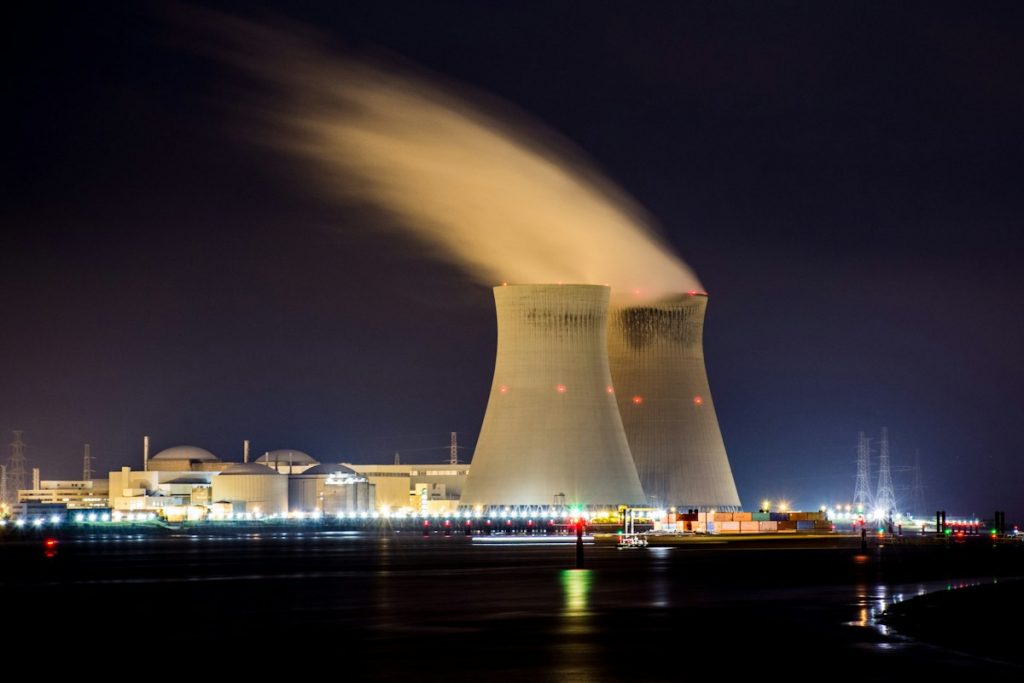
If you want to see whether small modular reactors can work commercially, the best place in North America to look is just east of Toronto. Ontario Power Generation is building the first of four GE Vernova Hitachi BWRX-300 units at its Darlington site, each rated at about 300 MW.
The milestones so far:
- The Canadian Nuclear Safety Commission issued a construction licence in April 2025.
- Ontario gave its final investment approval in May 2025, with a total budget of C$20.9 billion for all four units. Unit 1 and shared infrastructure account for C$7.7 billion.
- In October 2025, the Canada Growth Fund committed C$2 billion for a 15% stake, and the Building Ontario Fund put in C$1 billion for 7.5%.
- The reactor building’s basemat, a massive concrete foundation, was completed on April 22, 2026, according to the American Nuclear Society.
- OPG’s target is to connect Unit 1 to the grid by the end of 2030.
The costs deserve a hard look. On a standalone basis, Unit 1 is budgeted at about C$6.1 billion for 300 MW, expensive per megawatt by any measure. OPG argues later units get cheaper, falling toward roughly C$4 billion for the fourth. That’s the whole SMR thesis: build the same design repeatedly and costs drop. Darlington is the real-world test.
Darlington is not a data centre project. Its power goes to Ontario’s grid, where the Independent Electricity System Operator forecast in late 2024 that demand would grow 75% by 2050, with data centres making up about 13% of new demand by 2035. But every hyperscaler with an SMR deal is watching, because Darlington’s cost and schedule will shape their own expectations.
Canada’s data centre boom: Quebec and Alberta
Canada offers a cool climate, relatively clean grids and political interest in keeping Canadian data at home. In December 2025, Microsoft committed C$7.5 billion over two years to expand Azure capacity in Toronto and Quebec City, framed around digital sovereignty. The two provinces drawing the most attention, though, are taking very different approaches.
Quebec: cheap hydro, but not unlimited
Quebec has long marketed low-cost hydroelectricity to data centre builders. That is changing. Hydro-Québec has asked the Régie de l’énergie, the provincial regulator, to approve a rate of about 13 cents per kilowatt-hour for data centres needing more than 5 MW, close to double the current average of 6.82 cents. A hearing began on October 1, 2026, with industry players including Google taking part. Hydro-Québec says the facilities affected use about 190 MW at peak today and could reach 1,000 MW by 2035, and that it needs to protect the rest of its customer base from the cost.
Alberta: more requests than the grid can hold
Alberta pitched itself as a data centre destination, and the response overwhelmed the system. The Alberta Electric System Operator received transmission requests for more than 16 GW from large loads, mostly data centres, compared with a provincial peak demand of about 12 GW. The AESO responded with an interim cap of 1,200 MW for a first phase of connections, which was fully allocated to two projects by late 2025.
The province now prefers data centres that bring their own generation, typically natural gas. 2025 legislation also created a 2% levy on computer hardware for grid-connected data centres above 75 MW, starting December 31, 2026, reduced for self-supplied sites. That keeps grid costs off ratepayers, but it means many Alberta AI facilities will likely run on gas for now.
Is nuclear really the answer?
Nuclear is the story, but not the bulk of the near-term solution. The IEA expects renewables to cover about half of new data centre demand through 2035, with gas and nuclear each adding roughly 175 TWh. SMRs start contributing around 2030 and scale slowly.
There are good reasons tech companies like nuclear anyway:
- It runs around the clock. AI training doesn’t stop at sunset, and storing enough solar for 24/7 operation is still costly.
- It’s low-carbon. Microsoft, Google and Amazon all have climate targets their AI growth is making harder to hit.
- It’s a long-term hedge. A 20-year contract at a fixed price protects against volatile wholesale markets.
The risks are just as real. New nuclear has a long record of delays and overruns, only a handful of shut-down reactors are viable restart candidates, and the gap between a signed memorandum and an operating reactor is often a decade. Meanwhile, the IEA notes that gas turbines, transformers and grid connections are all in short supply, so even the fast options are slowing down.
There’s also a fairness question. If data centres drive up the cost of new generation and transmission, who pays? FERC’s rejection of Amazon’s original Talen setup and Hydro-Québec’s proposed rate hike give the same answer: not the household customer, if regulators can help it.
What to watch through 2030
A few markers will tell you whether this nuclear comeback is real:
- Crane’s restart in 2027. If it comes online on schedule, it proves the restart model works and could encourage more of them.
- Darlington Unit 1 costs and schedule. OPG reports progress publicly. Watch whether the C$7.7 billion envelope and the 2030 grid date hold.
- The Quebec rate decision. The Régie’s ruling, expected after a second phase of hearings in December, will signal whether Canadian provinces will keep courting data centres with cheap power.
- Alberta’s second connection phase. How the AESO allocates capacity beyond the first 1,200 MW will shape whether the province becomes a real AI hub or mostly a place for gas-fired, off-grid facilities.
- Efficiency gains. Every jump in chip and model efficiency reduces the power needed per query. Forecasts from 2024 may look too high in five years, or too low.
For Canadian startups, the opening has little to do with building reactors. Grid software, cooling, load flexibility, power electronics and the Darlington supply chain (more than 100 Ontario companies are already involved) are all seeing demand rise. The AI boom has made electricity the scarcest input in tech. The companies that help stretch it may end up as valuable as the ones that consume it.
Sources and further reading
- IEA: Energy and AI, executive summary (April 2025)
- IEA: Data centre electricity use surged in 2025 (April 2026)
- World Nuclear News: NRC and FERC boosts for Crane Clean Energy Center
- Constellation: Q2 2026 results and Crane update
- DatacenterDynamics: AWS and Talen sign PPA for 1.92 GW
- Amazon: Cascade Advanced Energy Facility and X-energy
- World Nuclear News: Google, Kairos Power and TVA collaboration
- American Nuclear Society: Construction at OPG’s Darlington SMR
- World Nuclear News: OPG secures government equity for SMR project
- BLG: Data centre regulation in Alberta (July 2026)